Amazon
Outbound
2025
Overview
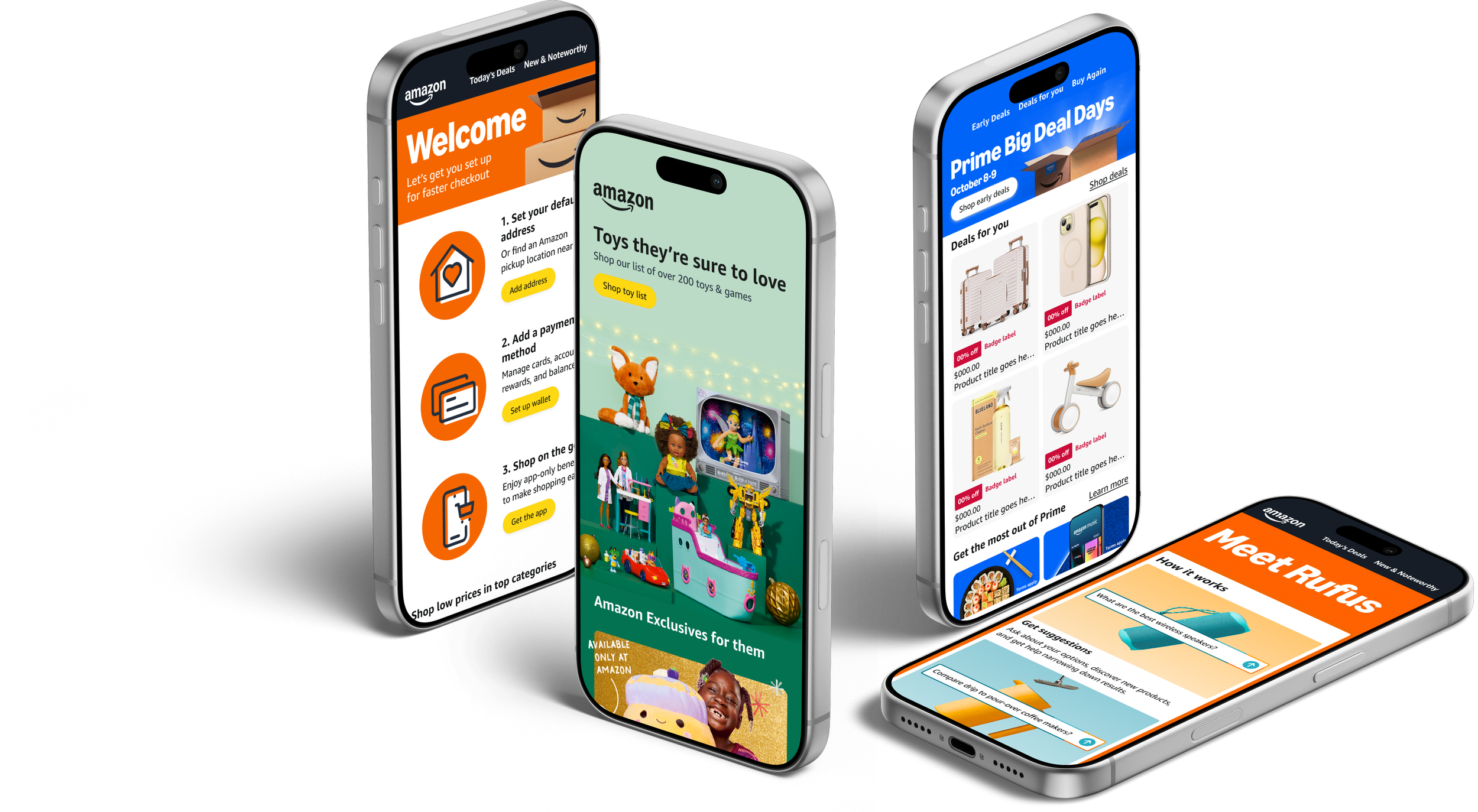
Amazon Outbound is a cross-channel lifecycle messaging program within Amazon that delivers timely, relevant customer communications through email and push notifications. It supports marketing, onboarding, and engagement initiatives at scale, enabling teams to reach millions of customers with consistent, high-quality experiences. Amazon is trying to focus on creating and maintaining more consistent and scalable outputs through all their channels versus each market creating a different design of their own.
In this initiative, Amazon reached out to us in 2023 to form a partnership with our agency for help to jump start their goals through collaborative efforts in order to establish, grow, and maintain outbound communications across a range of markets. Initial objectives included multi-content email design and exploration, as well as putting new templates through testing via live high velocity campaigns such as Prime Day.
❋ Role
Art Director | Interaction Designer
❋ Duration
2+ years
❋ Tools
Figma, Photoshop, Adobe Creative Suite
❋ Deliverables
Prototypes
Mockups
Templates
Design System
Emails
Push Notifications
and more
Challenges
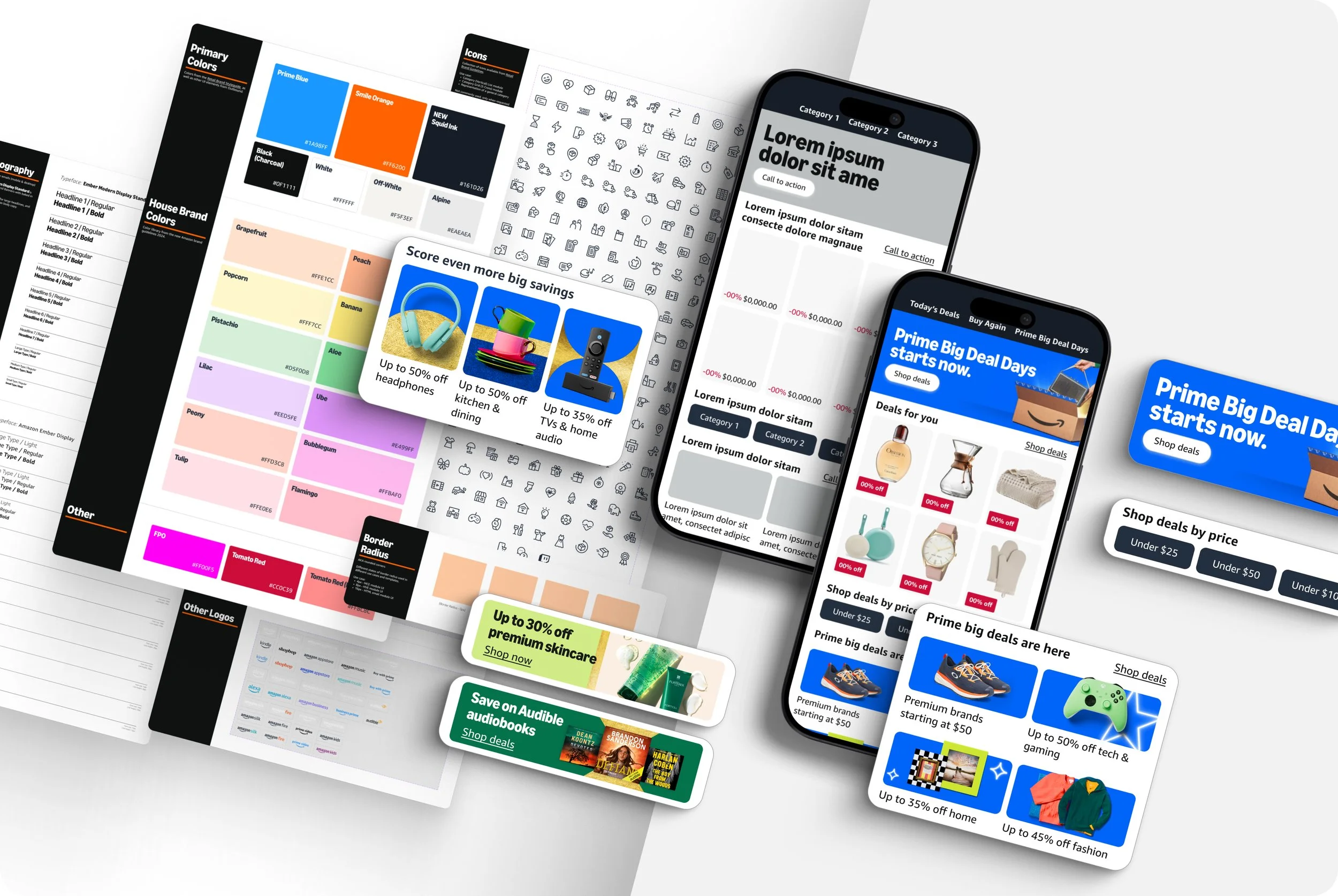
How do we design scalable templates that don't feel templated? How do you maintain consistency while delivering the elevated, personalized experience that drives user action?
Amazon was in the middle of a huge rebranding but it positioned us uniquely: we could help shape how lifecycle communications would work under the new brand identity, not just conform to it.
Not a simple design task. As rebranding happened, business goals shifted, and we had to pivot to ensure our designs and ideas continued to align cross-functionally.
Solutions
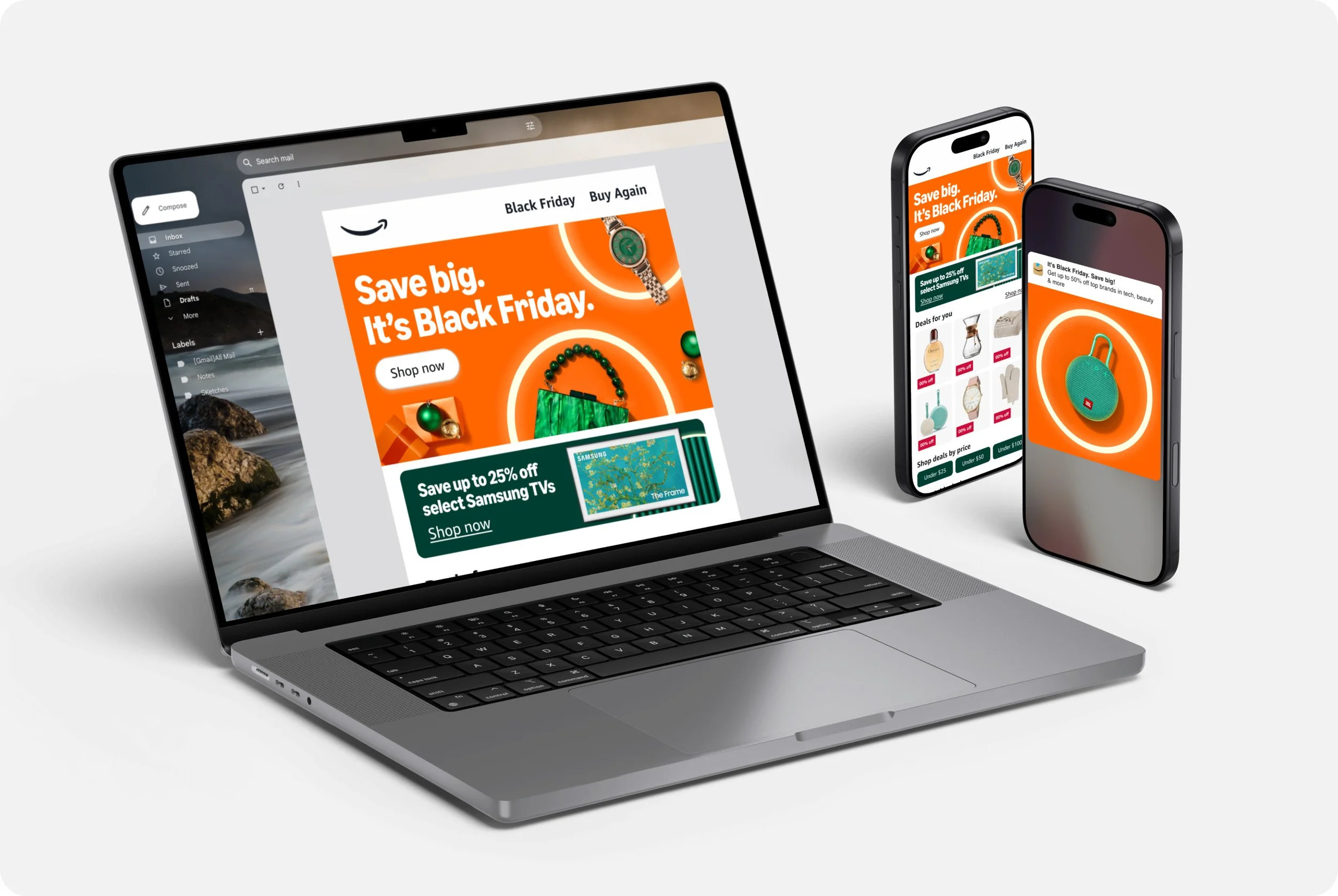
Seamless experience — Users encounter Amazon across multiple touchpoints. If an email promised something, the Prime app needed to deliver on that same experience. This consistency drives higher engagement and reduces user friction.
Invisible Modularity — Layered in motion design and refined micro-interactions within the modular system and using reusable components to scale without sacrifice.
Tiered approach — Modular templates for everyday communications and time restrictive projects, and custom HTML for strategic, new channels and campaigns at a smaller scale that allowed time for exploration and testing.
Testing live product — New custom designs tested against the previous templates to measure the impact of specific design decisions (visual hierarchy, copy hierarchy, color choices, layout) on user engagement and conversion. Iterated based on what worked, not assumptions.
Results — Clickthrough & revenue
Competitive Testing Framework — Validated against existing high-performers through A/B testing in real campaigns. Feedback loop: design → test → learn → refine.
Example: Holiday Toy HTML email — Outperformed the legacy design by 7.21% increase click-through rate. In practical terms: on 127M emails, this meant ~9.1M additional customer clicks.
A single campaign email generated $63.5k in incremental revenue. When extrapolated across our portfolio of high-impact campaigns, this represented significant revenue uplift that could scale across markets.
Impact & Learnings
Working within brand guidelines, technical limitations, and global needs forced more elegant solutions and outside the box thinking. What really landed was the inclusion of motion and making emails feel like a curated experience.
Pushing for elevated design decisions have massive impact. A 7.21% improvement in CTR doesn't sound huge until you do the math — 9.1M additional customer actions. Not every decision needs to be revolutionary; sometimes refinement within existing constraints is more powerful than innovation.
Assumptions — What would push for better performance? This needed validation. More testing became adopted in future campaigns. Hypothesis → test → learn → iterate. Design opinions matter less than user behavior data.
View more case studies